Showing posts with label Planning. Show all posts

Saturday, September 22, 2012

...and move it all around

Tempus fugit! It's already been more than a year since our first post (Hello there world - August 9, 2011). Wow! Never thought we would still be doing this after a year. But here we are, non the wiser. Well, maybe just a bit wiser.

When we started everything was going great, full steam ahead. We were producing lots of tomatoes, peppers, cucumbers, flowersstrawberries, etc. Happy times! All that stopped a few months ago. Plants languished, production went significantly down, growth stalled. Part of it was poor care and maintenance (mea culpa) but that couldn't be the whole problem. Something else must be at work. After some deep thinking (and online research) I think we might have stumbled upon the root of the problem: Soil.

Soil!? But isn't soil one of the advantages of container gardening. Not having to worry about it. So we thought. In sub-tropical climates container gardeners rarely have to worry about soil. They plant at the beginning of the season with fresh soil and at the end of the season when plants die soil is discarded (or even better, used towards the compost bin). Fresh soil is then used when spring comes around. In tropical climates where perennial plants are common soil becomes an issue.

Here's what happens to soil after time passes.

1. Nutrients are depleted - Nutrients are depleted from the soil as plants consume them. Not a real issue with containers since we administer fertilizer on a regular basis (you are administering fertilizer, right?).
2. Soil collapses - Soil tends to collapse and become compacted. Nutrient absorption may be reduced due to this. However, this is usually not a big concern in containers.
3. Pests and diseases - Pests and diseases develop in soil as time goes by. These organisms may become dormant until the right conditions (temperature, host, etc) are present. Diseases typically affect a family of plants rather than a single species. Very important since a few common plants (tomatoes, peppers, potatoes) belong to the same family (Solanaceae).

Pests and diseases are the biggest concern to reusing soil. Soil harbors many types of viruses and bacteria. Healthy, mature plants are barely affected by these organisms. However, young plants are vulnerable (plants behave similar to humans, the young and the old are usually the most prone to disease). Therein lied our problem. We had a few combopots with spices, greens, ornamentals, and fruits. Spices are, with some exceptions, perennials; greens are annuals; ornamentals may be either annuals or perennials. Fruits usually have to be replaced after a season, two at the most, since their production is greatly reduced as time goes on. Since we didn't want to lose our spices and herbs we kept out pots intact, soil and all. Mistake 1. Then we went and compounded our mistake with Mistake 2: Replanting species in the same containers. Right on cue diseases started attacking our young plants with most plants never being able to produce fruits.

If you have monopots the solution is simple: Discard soil at the end of the growing season. But what to do with combopots where soil cannot be completely discarded? There is a simple solution. Crop Rotation. This technique is used by large scale farmers around the world. The idea is to move crops around and not grow plants from the same family in consecutive seasons. So if you planted tomatoes in one container your next crop could be arugula or lettuce. If you had peppers then you can alternate them with strawberries or onions.
Simple, right? So learn from our mistakes and rotate your crops.

Saturday, August 25, 2012

In Living Color

Seed grown Coleus in a white container with
some common green plants.
Red and green are complementary colors
We've been away for two weeks visiting a slightly larger island than Puerto Rico called Great Britain. We weren't there on any gardening related adventure (rather just catching some Olympic games) but we saw some interesting concepts that we will probably cover later. <End Completely Unrelated Sidenote.> In our last post (we trust that you read it, but just in case here's the link) we talked about planning your garden, about the importance of a theme. We also talked a bit about taking into consideration the shape and color of your plants to make your garden and containers more interesting. According to Ray Rogers writer of The Encyclopedia of Container Plants (highly recommended) there are five plant design attributes: color, line, form, space, and texture. Today we'll present an example of how to use color in your garden although we're by no means experts (wow, that's a shameless plug of our motto).

Simple color wheel containing primary, secondary,
and tertiary colors
Color theory revolves around the use and combination of primary, secondary, and tertiary colors. We will not go into a detailed explanation of how color theory works (mainly because I don't understand it well myself but also because the link provided does a pretty good job itself) but suffice it to say that the idea is to combine colors which complement each other. A color wheel is very helpful for those of us who need a visual aid to remember how colors interact with each other. When designing your garden you need to consider not just the color of your plants but also the color of the container, background, and even the surrounding plants. Doing so will allow you to create magazine quality displays. Most people relate color in plants to flowers. Understandable with plants being primarily green. The problem is that flowers (with some minor exceptions) are fleeting, delicate things. One day they're here, the next they're gone. Thankfully, there are some plants that are able to add color to a container without producing flowers. One in particular is the example we wish to provide today, Coleus.

White variegated coleus
growing around a bromeliad.
According to Wikipedia the name Coleus was an earlier genus that scientists have recently divided between two genus: Solenostemon and Plectranthus (cookies for anyone who remembers another plant from this genus. Hint: it smells like oregano). There are hundreds of species and cultivars sold as Coleus. Any of them can make an interesting addition to a container garden but we are mainly interested in Solenostemon scutellarioides and its various cultivars. This species occurs naturally in the tropics (Southeast Asia) where it is considered a perennial. In colder climates it is grown as an annual. It generally prefers partial shade but new cultivars have been created that are better suited for full sun. Depending on the cultivar it can trail close to the ground topping at only 4 inches or grow up to 3 feet tall. The size of its leaves is also very varied with some being as small as a few inches while others can grow as large as a foot. Propagation can occur by seeds or though cuttings. The more stunning cultivars are available through cuttings only so you will need to buy young plants from your nursery for the ultimate color punch. We've grown both seed and cutting varieties and the difference is significant (contrary to our usual stance cuttings > seeds).

Two small Coleus and a Bromeliad on an orange container.
Purple, red-orange and green are split-complementary colors.
The reason we love Coleus so much (and the reason we are using them as an example today) is its leaves, which come in every color under the sun, except blue. (Interestingly enough the flowers from the original species are blue, flowers of the cultivars might have other colors) These leaves are usually variegated which adds to the interest. With so many colors it's no wonder that this is one of the most popular garden plants. Young plants are usually available in the nursery all year round but are more prevalent in spring or early summer. Once you select the plants you need to determine the sun conditions under which they will thrive. Too little or too much light may cause the leaves to lose color. Start the plants in partial shade and gradually move them into higher sun intensity. Each plant will let you know how much light it's able to tolerate. Soil must drain well and be maintained evenly moist. After a few months flowers will emerge from long stalks. We recommend pinching them to promote bushy, compact growth although some people like the flowers (to each its own I say). We recommend a balanced fertilizer every 2 weeks. As far as pests are concerned we've seen some aphids and whiteflies which haven't adversely affected growth.

Now that you know how to grow Coleus it's time to use it. Again the basic principle is to combine colors to create a stunning display. Since most plants are green you can use Coleus to break the monotony in any container. For example, you may use a red Coleus in a herb container. Herbs are primarily green and red is a complement of green so this combination should work well. Another useful Coleus color is purple. Why? Since most containers are orange (terra cotta) and most plants are green adding purple creates a triadic color scheme. This will result in an extremely vibrant display so use with moderation. Black and white Coleus go well with almost everything so having a few plants of these varieties is always recommended for mixing and matching. Well, you get the picture. Any Coleus can be used to provide an extra punch to each and every display.

So what are you waiting for. Read up on color theory and show us how you use color in Coleus to create stunning containers. Until next time keep on gardening.

Thursday, July 19, 2012

Garden Makeover

Rusty garden table
A smart approach is to start your garden with a theme in mind. This way you can plan ahead for appropriate pots, plants and decoration. After all you want a practical garden that has visual impact and good looks.

For starters, think if you want an edible or an ornamental garden. Our recommendation is a combination of both where you can have fresh ingredients for cooking, and color, texture, and visual impact with ornamentals. Remember to take into consideration your space size and environmental conditions such as the hours of available sun and wind. As a good rule of thumb herbs require at least 6 hours of sunlight while flowers and other ornamentals may require less.

Before the makeover
When we started our garden we didn't have a theme in mind. Actually this whole gardening madness started because I like to cook and I wanted a windowsill garden for a few herbs. (I'm actually helping a friend create hers, keep tuned for this upcoming interesting post.) Turns out our sweet basil grew so much we had to transfer it to a large pot and so our balcony garden started. In the beginning it was mostly the pots we could get, all placed across the balcony floor. (Editor's note: Not the best floor plan for a garden.) 

There is an excellent gardening book which has a lot of information on the different plants that could be appropriate for containers: The Encyclopedia of Container Plants. The author, Ray Rogers, has won numerous awards for plant displays and flower shows, so the book presents lots of ideas about the different combinations you can do based on the shape of the leaves, and the color of the plants and flowers. We have learned about the best combinations and decided to experiment a little (yes, always leave some space/time for experimentation).

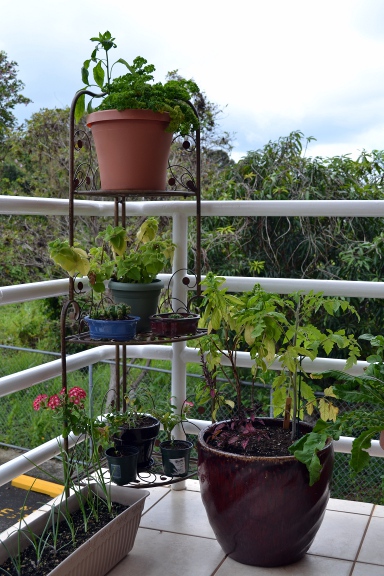
It was time for a garden makeover! We went shopping and found some interesting pots and colorful garden tables. After pondering for a while (Editor's note: "a while" = hours) we settled on a rusty theme, which will prove to be very convenient in Puerto Rico's high humidity. We selected several rusty metal tables but incorporated a few wooden pieces and pots that also have rusty accents. 

Color palette is important too. You can use a color wheel to decide on good combinations. Play with analogous colors, which will prove very useful for edible leaves or maybe mix and match complementary colors using your flowers. For our new pots and tables we selected colors that are not too bright but which include white, yellow and some blue and purple. Since most of our plants are just green, we wanted to add some color without overcasting our flowers.

There are also other ideas you can incorporate into your garden. One of our favorites is creating theme pots. You can create a pot that is all about salad, mixing and matching different edible greens like arugula, lettuce, scallions. Combine aromatic plants like basil, parsley, lemongrass and rosemary for a more romantic touch.


After the makeover
As you can see in the picture above, the change is not over-dramatic, but it does add great touches, it looks more organized, it has more shape and depth, it displays better the smaller plants as they don't disappear into larger ones. Every once in a while we rearrange them either because plants achieve their their lifespan or because we get new plants always taking into consideration shapes and color.

We will keep improving our garden and as always, keep you posted. We might start introducing some trees to our garden arrangement. Don't miss the updates.

Monday, December 12, 2011

Getting back on the horse

After two weeks sightseeing in India we're back (and better than ever?)! Time to get back on the horse and do some gardening.

Even with a garden-sitter some of our plants suffered while we were on vacation since our friends went away for Thanksgiving. This left our plants without water for 3-4 days. As a result we lost our cucumbers (which were already struggling), a cherry tomato (which was already struggling), our bell peppers (which were already struggling due to an aphid infestation) and a few seedlings. I hope you saw a pattern there. Basically, all plants which were already weak or young were lost. Every other healthy plant was spared although some (such as our miniature and our new cubanelle pepper) were weakened and attacked by aphids (Damn you aphids. Why won't you go away! Mental note: Write a post about aphids). But alas not all is bad news. Our arugula looks gorgeous and the small leaf oregano has spread considerably. Also, some basil seedlings have matured and the payasitos are starting to bloom and multiply.

With all that being said we're ready to get back on the horse (Didn't we say that already?). Yesterday we planted some cucumber and bell pepper seeds to replace the ones lost. We previously had 3 cherry tomato plants which produced more tomatoes than we can consume (and gift to friends). Therefore, we're looking into what we can plant to substitute the cherry tomato plant. Maybe a plum tomato, some heirlooms tomatoes, a few lettuces, some flowering plants, who knows. That's one of the great things about container gardening. There are hundreds of possibilities to choose from; a little something for everyone. Keep tuned for more information and for updates on our little container garden.

Sunday, November 20, 2011

Going away? Plan ahead

We're going to take a little vacation soon which means we need to prepare. The last time we left for a few days our cucumbers suffered (see A Death in the family). It also means no posts for at least two weeks! (It also explains why we haven't posted anything in a while. Planning a vacation is time-consuming) So what things you need to take into account when you're going on vacation?
  1. Watering - Your first (and probably only concern but we threw a few additional ones just for the fun of it) concern should be watering. Your plants might survive a day or two without water outside and maybe 3 or 4 days if you move them inside. For short trips you can get some water bottles or 2 liter soda bottles and fill them with water. Make a small hole in the cap and insert the bottle upside down in the soil. Water will slowly trickle out as the soil dries out. If your time away will be longer than a few days then we suggest a garden-sitter. We recommend that you take this person to your garden and instruct them on how to water your plants.  Also, you can mix water retaining hydrogels into your soil. This will increase the availability of moisture in your pots. There are also automatic watering solutions but we cannot comment on them since we haven't tried them (Crystal ball: I see a future post about this topic).
  2. Pruning - Take this opportunity to do a little pruning (Editor's note: Joel hates pruning but he knows it's necessary). This will help reduce the water requirements of your plants. 
  3. Harvesting - Harvest as many fruits and vegetables as possible. Also teach your garden-sitter how and which plants to harvest while you are away. They won't mind eating some fresh vegetables while you're out.
  4. Location - Since you have a container garden you also have the opportunity to move your plants to a shaded location. This will obviously reduce the water requirements for your plants.
These tips should help you in keeping your garden alive while you enjoy your days away. We'll be back in a few weeks. Until then keep on gardening!


Sunday, October 2, 2011

Hold Me Tight


We used a net to support our cucumbers
Let me come out clean and say this at least once: We haven't been the best planners when it comes to our garden. Partly because of inexperience, partly because of laziness and partly because of plain old stubbornness (that last one applies to me only). But our loss is your gain and we hope you learn from our mistakes. Today's topic is something we did not fully take into consideration when planning our garden. Trellises. A trellis is a structure made of metal, wood, bamboo, plastic, or even rope used to support vines or climbing plants. Trellises come in many shapes and sizes. What you choose will ultimately depend on your garden space and needs.

When planning your garden take into consideration the growing habits and final size of your plants. Common plants such as tomatoes, cucumbers, grapes, beans, climbing roses, and peas require a trellis for proper growth. Vines require a trellis for growth but also to support its fruits. How a vine climbs will determine the type of trellis you use. Some vines, such as cucumber, use tendrils to secure itself to any structure. Other vines use its leaves or stems to wrap around structures. As a general rule of thumb thicker structures are needed for "wrapping" vines while thinner materials may be used for "twiners". For our cucumbers (a "twiner") we used a net tied to our balcony posts for support (see picture above). We helped the plant by loosely wrapping the tendrils around the net. After a few hours the tendrils will coil and wrap themselves tighter thus securing itself.

Bamboo fence used as a tomato trellis
Tomatoes, on the other hand, are not a true vine. However, their stems are extremely weak and require a trellis or a cage to hold the plant (and fruits) in place. If you don't provide a trellis your tomatoes will grow on the ground or, as we can attest to (see the classic Man Down! post), your plant may break. We eventually learned our lesson and bought a retractable bamboo fence for our tomatoes. We tied the fence to our balcony posts using plain old tie wraps. Then we tied the stem and branches to the trellis using garden training wire.

It is always recommended that you secure your trellis to your pot or to a strong structure. Otherwise it may shift during strong winds, heavy rain, or under heavy weight. Also, metal trellises are not ideal to use in Puerto Rico because they tend to get hot and burn your plants.

Almost any material can be modified into a trellis. This post barely scratches the surface on trellises. The only limit is your imagination. So share with us what you've used to provide support for your plants and join us next time for more on container gardening in Puerto Rico.

Sunday, August 21, 2011

Tropical systems and your garden

Tropical Storm Irene
Tropical storm Irene is at our doorstep but that won't stop us from publishing (unless the internet goes out!). Actually, the storm served as my muse for today's post. In case of a predictable natural event, such as a hurricane or tropical storm, container gardening in Puerto Rico offers an advantage over in-the-ground gardening; the ability to move your plants. Most plants that we grow on containers would be heavily damaged or destroyed during a hurricane or strong tropical storm. With sustained winds over 75 miles per hour you can imagine the state your tomatoes will be after a hurricane. With careful planning all your plants can survive a natural event.

When planning your garden make sure you are able to move all of your plants. Place large, heavy containers on top of a dolly or other wheeled object. Make sure your trellises and other supporting structures are easily removable. Water shouldn't be a problem since it will be plentiful outside but having 2-3 days worth of water for your plants wouldn't hurt. Plants will require less water than usual since they won't be exposed to wind and sun. Do not worry about your plants not receiving enough sunlight for a few days. Your plants will survive.

That's all we have for today. Follow these simple guidelines and your plants will be safe. If you are in Puerto Rico and growing a container garden get your plants inside. It's better to be safe than sorry.